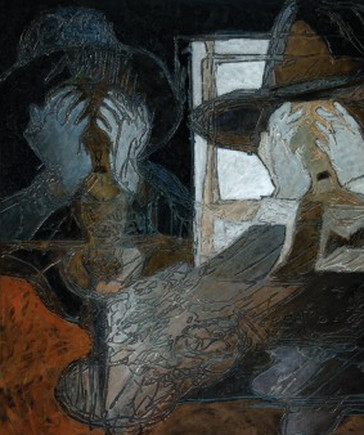
Fernando Pessoa| Norberto Nunes
Today, June 13 Google doodle celebrates the 123rd Anniversary of Fernando Pessoa, the Portuguese great writer of XXth Century!
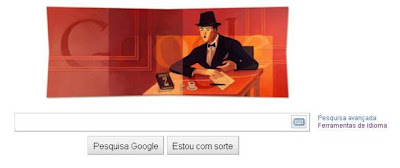

Google doodle - Fernando Pessoa
Fernando Pessoa was born in Lisbon on June 13th 1888. Following the death of his father in 1893, his mother remarried Commander João Miguel Rosa in 1895, who was the Consul of Portugal in Durban, Natal, where Fernando Pessoa was raised.
He was awarded the Queen Victoria prize for English at the University of the Cape of Good Hope in 1903, for his achievement in an exam at the age of 15.
Writing obsessively in French, English, and Portuguese, Fernando Pessoa left a prodigious body of work, much of it under "heteronyms" fully fleshed alter egos with startlingly different styles and points of view.
During his life, most of Pessoa’s considerable creative output appeared only in journals, and he published just three collections of poetry in English—Antinous (1918), Sonnets (1918), and English Poems (1921) - and one collection in Portuguese, Mensagem(1933).
He was awarded the Queen Victoria prize for English at the University of the Cape of Good Hope in 1903, for his achievement in an exam at the age of 15.
“Profession: The most correct designation would be “translator”, the most exact would be “foreign commercial correspondent” His poetry and writing were not his profession but his vocation."
During his life, most of Pessoa’s considerable creative output appeared only in journals, and he published just three collections of poetry in English—Antinous (1918), Sonnets (1918), and English Poems (1921) - and one collection in Portuguese, Mensagem(1933).

“He was a thin man, tenuous and frail, of medium stature, 1,73 m tall, slightly curved back. His chest was not well built; in fact it was quite sunken, despite the Swedish gymnastics he was practicing. He had long legs, not very muscular and his hands were slender and inexpressive. His awkward stride and fast pace, although irregular, denounced him at a distance.
He usually wore dark suits, grey, blue or black, at times short. He also wore a hat, normally wrinkled, and slightly tilted to the right.
“His face was long and dry. Behind his small round glasses, of misty thick lenses, small brown eyes were hidden. His stare, when fixed on someone, was observant and sometimes even mysterious. He had a small mouth and thin lips, which were almost always shut. He had an “American” moustache which conferred him a special charm." (...)
Education:
We have the honour to know that there are several schools all over the world that teach Portuguese Literature (Universities) and Portuguese as second language (Elementary and High Junior Schools).
Some months ago, I suggested in Languages matter post different activities for students about Fernando Pessoa's poetry.
"With today's technology every corner of the world is linked together. The new generations are globalized."
Irina Bokova, Director-General of UNESCO
Message for "International Mother Day 2011"
Teaching and learning about Fernando Pessoa poetry is easier now. Just link on the website Casa Fernando Pessoa and yours students have different resources in Portuguese and English about Pessoa
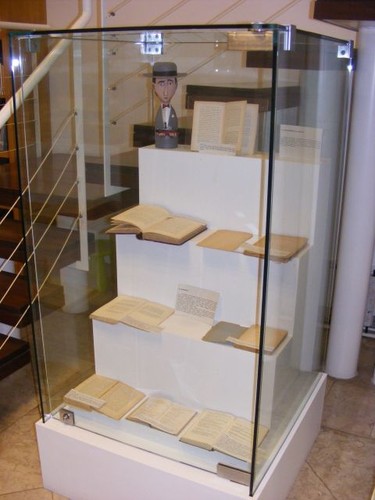
At the moment Casa Fernando Pessoa has an important bibliographic resource online containing some of the works which belonged to the poet personal collection read and annotated by Pessoa himself.
Due its importance and rarity, these works are normally inaccessible to the general public.
But now, acccording to criteria of conservation and preservation, these literary writings can be consulted on digital format

Fernando Pessoa has an unknown side of his poetry! He wrote poems for children. It's impossible not to teach these poems to the chidren. They are beautiful!
"Less than a quart of all languages in the world are used in education and in cyber space."
Irina Bokova, Director-General of UNESCO
Message for "International Mother Day 2011"
Here two different poems of Fernando Pessoa that chidren should read in Portuguese language:

As Fadas
Do seu longínquo reino cor-de-rosa,
Voando pela noite silenciosa, A fada das crianças vem luzindo.
Papoulas a coroam, e, cobrindo
Seu corpo todo, a tornam misteriosa.
À criança que dorme chega leve,
E, pondo-lhe na fronte a mão de neve,
Os seus cabelos de ouro acaricia –
E sonhos lindos, como ninguém teve, A sentir a criança principia.
Em coisas vivas, e um cortejo formam:
Cavalos e soldados e bonecas,
Ursos e pretos, que vêm, vão e tornam,
E palhaços que tocam em rabecas...
E há figuras pequenas e engraçadas...
Que brincam e dão saltos e passadas...
Mas vem o dia, e, leve e graciosa,
Pé ante pé, volta a melhor das fadas
Ao seu longínquo reino cor-de-rosa.
Voando pela noite silenciosa,
Papoulas a coroam, e, cobrindo
Seu corpo todo, a tornam misteriosa.
À criança que dorme chega leve,
E, pondo-lhe na fronte a mão de neve,
Os seus cabelos de ouro acaricia –
E sonhos lindos, como ninguém teve,
Em coisas vivas, e um cortejo formam:
Cavalos e soldados e bonecas,
Ursos e pretos, que vêm, vão e tornam,
E palhaços que tocam em rabecas...
E há figuras pequenas e engraçadas...
Que brincam e dão saltos e passadas...
Mas vem o dia, e, leve e graciosa,
Pé ante pé, volta a melhor das fadas
Ao seu longínquo reino cor-de-rosa.
Fernando Pessoa, Poesias Inéditas

Cristina Sampaio cartoon
Liberdade
Ai que prazer
Não cumprir um dever,
Ter um livro para ler
E não o fazer!
Ler é maçada,
Estudar é nada.
O sol doira
Sem literatura.
O rio corre, bem ou mal,
Sem edição original.
E a brisa, essa,
De tão naturalmente matinal,
Como tem tempo não tem pressa...
Livros são papéis pintados com tinta.
Estudar é uma coisa em que está indistinta
A distinção entre nada e coisa nenhuma.
Quanto é melhor, quando há bruma,
Esperar por D. Sebastião,
Quer venha ou não!
Grande é a poesia, a bondade e as danças...
Mas o melhor do mundo são as crianças,
Flores, música, o luar, e o sol, que peca
Só quando, em vez de criar, seca.
O mais do que isto
É Jesus Cristo,
Que não sabia nada de finanças
Nem consta que tivesse biblioteca...
Fernando Pessoa
You have a lot of activities for Elementary and High Junior Schools at the website Kidzlearn Lugares&Aprendizagens (Portuguese language).
"Multilingualism opens fabulous opportunities for the dialogue that is necessary to understanding and cooperation."
Irina Bokova, Director-General of UNESCO
Message for "International Mother Day 2011"
Education activities:
- Portuguese as second language in primary and elementary schools;
- Portuguese as foreign language in High Junior School;
- Portuguese Literature studies in foreign Universities.
In fact Pessoa’s work was a kind of open-sesame, insofar as it alerted the rest of the world to the rich literature being produced in a small country situated on southwestern Europe’s fringe - Portugal.
G-Souto
13.06.2011
Copyright © 2010G-Souto'sBlog, gsouto-digitalteacher.blogspot.com®
Casa Fernando Pessoa
http://casafernandopessoa.cm-lisboa.pt
Mundo Pessoa
http://mundopessoa.blogs.sapo.pt/
Poetry Foundation
http://www.poetryfoundation.org/bio/fernando-pessoa
UNESCO Director-General's message
Kidzlearn Lugares&Aprendizagens