Showing posts with label learning and teaching. Show all posts

Robotics in Education


http://robotica2011.ist.utl.pt


The 11th Portuguese Robotics Open took place in Lisbon, Portugal, April 6-10, 2011 at the Instituto Superior Técnico congress center.


The Portuguese Robotics Open, which had its 1st edition in 2001, aims at promoting Science and Technology among students from the 1st grade to university studies, as well among the general public, through robot competitions. 
The Festival takes place every year in a different city, and includes also an international conference where national an international researchers present their latest work in the field of Robotics.
The event has had an enormous growth since the 1st edition, both in the number of teams, participants and visitors. The Portuguese Robotics Open is currently an initiative of Portuguese Society of Robotics.


Robotic soccer


Young participants that love soccer, including robot soccer, aiming to become world champions such as their university colleagues that were world champions in 2008 in the RoboCup Middle Sized League. In this league they had the chance to test their assets and show the best of their skills in building and programming soccer robots.


Robotic junior dance
http://robotica2011.ist.utl.pt

Dance is a source of joy and happiness for all ages. Programming robots that dance autonomously is another source of joy for the young participants of this league, one of the most popular leagues of this event. Both programmers and robots danced all together sharing their joy with the audience.

Watch the video presentation (Portuguese language) below

The 11th International Conference on Mobile Robots and Competitions is an international scientific meeting in the field of Mobile Robotics technically co-sponsored by the IEEE and sponsored by the IEEE Robotics and Automation Society (RAS), through its Portuguese Chapter. 
Its scope encompasses, but is not limited to, the fields of Artificial Intelligence, Robotics and Education.


At the same time, last April 9-10, 2011 the "Fire-Fighting Home Robot Contest" took place in Hartford, Connecticut (USA). 

"Trinity’s annual robot competition, assistive robotics whose goal is to aid people with special needs and improve the quality of their lives – is playing an increasingly important role."

Altogether, about 125 teams – including those from Canada, China, Indonesia, Israel, Mexico, Portugal and, of course, the United States participated in what has become one of the premier robotics events in the world. 


Portuguese medail

The winner in the category "Junior Division 2011" was a Portuguese  team, students from ADoT "Associação Desenvolver o Talento", Guarda (Portugal).The two students team Miguel Seabra and José Delgado (12 and 13 years old) 
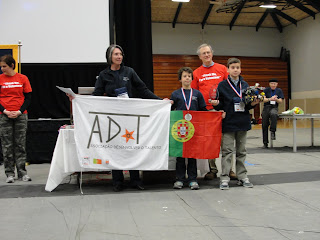


ADoT team winner and teachers


Desenvolver o Talento (ADoT), Portugal

ADoT is a Portuguese association to aid gifted young people and improve the quality of their lives.


Congratulations to ADoT students and teachers!


G-Souto
11.04.2011
Copyright © 2010G-Souto'sBlog, gsouto-digitalteacher.blogspot.com®


Credits: video SapoNotícias
            Photos ADoT


References:


The Portuguese Robotics Open 2011 (Portugal)
http://robotica2011.ist.utl.pt/en/


Trinity College Robot Contest 2011 (USA)
http://www.trincoll.edu


ADoT
http://adotportugal.blogspot.com/

Robotics in Education Seminar


O Centro de Competência em Tecnologias e Inovação, do Instituto de Educação da Universidade de Lisboa, vai realizar no próximo dia 13 de Janeiro, às 16h00, um seminário subordinado ao tema Robótica Educativa.

Este evento decorrerá no Anfiteatro do Instituto de Educação (Edifício da Faculdade de Psicologia e Ciências da Educação, na Alameda da Universidade).

A entrada é livre mas sujeita a inscrição prévia.

Poderá ler o programa aqui


Robotic in Education Robotic will take place in Lisbon, Portugal, January, the 13th - 2011 at the "Centro de Competência em Tecnologias e Inovação" of the Instituto de Educação Universidade de Lisboa.

Read the programme here (PT). You must register for free here

O kit de robótica LEGO MINDSTORMS NXT foi desenvolvido pela LEGO essencialmente para a educação e reúne condições particularmente vantajosas na aprendizagem da programação. 

Pouco utilizado em Portugal, o kit Lego Mindstorms tem vindo a ser utilizado no Ensino Básico e Secundário noutros países, nomeadamente, nos Estados Unidos da América, na Dinamarca e no Brasil, com relatos de bons resultados. 

Segundo Carlos Almeida, a sua utilização seria um sucesso no âmbito do Ensino Básico ou nos cursos profissionais bem como a sua integração nas disciplinas de programação. 

O kit LEGO MINDSTORMS poderá também ser utilizado em projectos realizados nas escolas e na preparação e participações futuras dos alunos em concursos de robótica, como por exemplo, o concurso anual robotop.

Para participar nas diferentes competições, os alunos poderão ter entre oito e dezanove anos.


The LEGO MINDSTORMS NXT robotics kit was developed by LEGO primarily for education and have the all the advantageous in learning programming.

In Portugal, schools don't use it very much, but there are some countries such as the United States of America, Danemark and Brazil that use it in primary and elementary schools with good feedback.  

The kit LEGO MINDSTORMS can help students in robotics projects in order to participate in robotic contests, for example, the Robotop contest.

Exit Camp for Girls the young Portuguese girls showed their talent against the British team that were participating in an equivalent program that runned on IBM in the UK. The victory of the Portuguese robots against the British team was a very interesting point.

The aim was to promote Technology among young girls to increase gender equality in their future career.


Last December, the 30th - 2010, The Guardian published "Dawn of the age of the robotic" by Marina Gorbis, futurologist and head of Californian thinktank The Institute for the Future.


"Advancement in robotics will dominate next decade"
Marina Gorbis, head of the Institute for the Future


G-Souto
07.01.2011
Copyright © 2010G-Souto'sBlog, gsouto-digitalteacher.blogspot.com® 


Media & Learning Conference


"Developing, Recognising and Embedding Media in Education and Training: Towards the Era fo Digital Fluency"

The Media & Learning Brussels 2010 conference was organised by the Flemish Ministry of Education and Training and the media company ATiT with the support of the European Commission, DG Education and Culture in the context of the Belgian Presidency of the European Union. 


Media & Learning Conference
Flemish Ministry of Education

It took place on 25-26 November 2010 in the Flemish Ministry of Education and Training headquarters in Brussels and involved over 230 participants from 31 countries who discussed together the application of media in teaching and learning. 

The conference evolved around three main themes:  

• Digital and media skills and competences
• Fostering the creation of media-based resources at all levels of education and training
• Use and re-use of existing media resources in education and training


Pascal Smet/ Welcome Plenary sesssion
Flemish Minister for Education


Media literacy and digital fluency are amongst the most important skills young people can learn or improve in order to find, use and create accurate information to become good creative citizens of a future society. But how can we as educators be sure that our learners are learning better thanks to media? 


"Media literacy is the ability to access the media, to understand and to critically evaluate different aspects of the media and media contents and to create communications in a variety of contexts."

Based on the shared goal of  digital fluency for all, the conference organisers set up the event to provide participants with an opportunity to  consider  digital media and media literacy in new and hopefully radically different ways. 

The idea behind this conference was to help  launch a real and ongoing community of practice of those interested in how best to harness the promise of traditional and new media in the service of learning.


Hans Laugesen
GL, National Union of Upper Secondary School Teachers/Denmark


The conference programme was  highly interactive and allowed for maximum networking and sharing of experience with a mix of plenary, discussion, demonstration and workshop sessions.


ICT and media literacy – the policy framework

Hadewych auditorium


During two days practitioners, experts and researchers have discussed how learners handle video and audio in a meaningful and thoughtful manner to support their learning, how media repositories complement existing teaching and learning materials effectively, how young people learn by creating their own media and how ICT can enhance the teaching and learning process.


"Media literacy relates to all media, including television and film, radio and recorded music, print media, the Internet and all other new digital communication technologies. It is a fundamental competence not only for the young generation but also for adults and elderly people, for parents, teachers and media professionals."


http://ec.europa.eu


Paul Ashter/ BBC Teachers TV

European policy as well as national policy came under discussion with presentations on the Digital Agenda, Digital Competencies and Media Literacy and Culture. Online and face-to-face discussions on topics such as the best way to teach media literacy and meeting the costs of multimedia-rich educational games attracted a lot of attention, as did the many and varied examples of media usage in schools and colleges. 


By mixing the conference with the annual MEDEA Awards which reward excellence in the application of media in learning, the conference programme  combined excellent practical examples of media usage.


The workshops given by previous MEDEA Award Winners and Finalists met different participants, most of all,  practitioners who were curious about the experiences.


This year’s Media & Learning Conference  focused on a changing view of media literacy and developing digital media skills in education, and two core themes emerged as being central. 


Keynote speaker Paul Bottelberghs


The first revolved around the fact that  society has evolved from a literacy culture to a media culture.


(...)


The second main theme that emerged was that the classroom, university lecture hall or training lab is the place where media needed to be contextualised and perfected

Participants were very enthusiastic about the richness and diversity of the examples of media usage from all over Europe that were shown, serving to highlight the ‘art of the possible’ to everyone who took part.

I chose to participate in the Hadewych auditorium sessions, most of the time, to be informed of the new discussions about ICT and Media Literacy across Europe. 


Really liked "Media literacy and culture" by Matteo Zachetti, DG EAC-D. He is responsible for the Media Literacy initiative and the Media Programme Pilot Projects. You can access to his speach here.


Ciarán McCormack, FÍS and IADT, Ireland
Fis bookclub project

http://www.media-and-learning.eu


A showcase project I enjoyed! The Fis BookClub from Ireland. Not a new idea but an interactive project to encourage young students to enjoy the benefits of reading. 
On the project, children create a video book review based on their independent  reading. The concept is simple but convincing. 


From the discussions, I took part in the panel "Is media literacy best taught as a unique subject in primary and secondary schools?" moderated by Paul Ashton. The panelists Hans Laugesen and Jim Devine spoke about some innovative practices in their own countries.  


Francesc Pedrò/ OECD
Senior policy analyst with OECD


The Closing plenary, Friday the 25th, had features keynote presentations "Connected Minds. Is technology changing students expectations?" by Francesc Pedró, (OECD) and BBC News School Report by Ros Smith, BBC, UK.


I really liked the analysis of Francesc Pedrò. Access to his speach here. As last year, in the New Millenium Learners Conference, Dr. Pedrò presented a very clear analysis concerning "growing importance of connectedness" in education.


Ros Smith/ BBC, UK


BBC News School Report has been the "MEDEA Overall Award Winner 2010" & "Professional Production Award Winner 2010". Part of the original team that set up BBC News School Report, Ros Smith is the Deputy Editor on the project.


"BBC News School Report" gives 11-14 year-old students in the UK the chance to make their own news reports for a real audience. Using lesson plans and materials from the BBC News School Report website, and with support from BBC staff, teachers help students develop their journalistic skills to become School Reporters."


Such an interesting project! As I often say, students like to take an active role in their learning as learners: creating, communicating, and collaborating, on  methodologic tutoring, of course - formal and informal.

The MEDEA Awards Ceremony took place on Thursday 25th November alongside the "Media & Learning Conference" and the winners of this year’s awards has been announced.


MEDEA Award/ BBC schoolreporter
Ros Smith


As final comments:


Media literacy is not a new subject, but a new educational language. As Dr. Pedrò said, digital literacy must be revisited (in curriculum, in teacher standards and training). Young people cannot live unplugged.1)

Educators and learners are doing fantastic things in schools! They have wonderful projects, they are envolved in a innovative teaching and learning process.

TV Education is 'on the road' again! Twenty years later, TV supporting teaching and learning is a 'new' media tool (revisited) for educators and learners.

Twenty years ago, I was an educator on TV Education in Portugal (1975-1985). I'm proud to be a digital pioneer! Yes, I am!

I have my degree  focus on TV Education from CNDP and BELC, Paris. Those years teaching on TV Education gave me a new dimension and a different vision as an educator EAD and face-to-face. 

My students used media devices since very young in the classroom. And they handle with digital tools in formal and informal learning. 

So, I could practice teaching and learning in a innovative way some years ago, even when the educational world didn't talk so much about media literacy!


I belong to a group of educators who have pushing out the bounderies of creativity and innovation.

I can say that secondary schools have been pioneers and  more innovative  than universities using media devices. 


Oh! An interesting SMS messaging have been used during the conference to support networking.

Congratulations to the conference team! Specially to Nikki Cortoos that I finally met, after two years working together online,  and Sally Reynolds.

Thank you so much for your invitation, as a member of the jury, to participate in the conference and in the MEDEA Awards  ceremony!


G-Souto

15.12.10
Copyright © 2010G-Souto'sBlog, gsouto-digitalteacher.blogspot.com®


References:


Media & Learning Conference
BBC News Report

1) Francesc Pedrò, Connected Minds. Is technology changing students expectations?, Media & Learning conference, Brussels, 26 November 2010