Showing posts with label high technology. Show all posts

The Endeavour ' live ' at Sciences classroom


The space shuttle Endeavour lifted off two days ago, May 16, for its final mission.
Tens of thousands of people crowded in and around the Kennedy Space Centre in Florida for the launch of the shuttle's 16-day voyage.
Nasa is planning just one more flight, of the Atlantis in July, before the 30-year shuttle programme is shut down.
"As Americans, we endeavour to build a better life than the generation before and endeavour to be a united nation. In those efforts we are often tested," (...). "This mission represents the power of teamwork, commitment and exploration. It is in the DNA of our country to reach for the stars and explore"
Captain Mark Kelly
Commander the flight


Photo: NASA
NASA says that since Endeavour's launch in 1992 it has travelled more than 100m miles over 25 flights. 
The six astronauts on the shuttle marked the final flight of the Endeavour by posing for a re-enactment of the poster promoting the most recent Star Trek film.
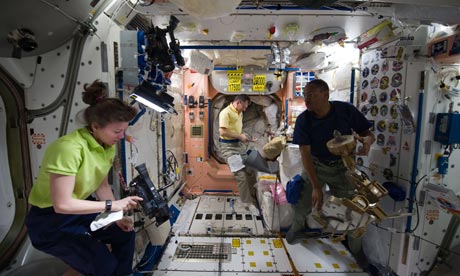
Photograph: Nasa/Reuters. 
Education:
It's impossible to ignore such an important live resource in the Sciences classroom. It's a good opportunity to encourage the students to think about space exploration and its implication to innovation and astrophysics development.


Educators have different resources for different school levels: from primary school to secondary school on NASA Education.


Endeavour crew
Photo: UPI/ Joe Marino/ Bill Cantrell
And NASA TV has a full-time HD Channel available at no cost to cable and satellite service providers. Live coverage of space shuttle mission is online now 24 hours for all. 


So, put on students' devices and link them on this fantastic 'live' classroom!

The students can watch, debate and learn about the space history since the early years until this last mission.


On NASA Education, there are available imagery from NASA’s vast array of space satellites, as well as media briefings, presentations by expert lecturers, astronaut interviews and other special events, all in the improved detail and clarity of high-definition.


The students can find a growing collection of 3D models, textures, and images from inside NASA here. All of the resources are free to download and use.


There are interactive features here.


Even more powerful the Robonaut experience.

And why not watch the video below of the very first moon landing of the Apollo 11 mission in 1969? 

Neil Armstrong was the first man to set foot on the moon with his now legenday words:

 "One small step for man, a giant leap for mankind." 


Impressive at the time! Even now! And the quality of the video! It was in 1969! This is a truly amazing video!


Tomorrow, May 19 PBS NewsHour correspondent Miles O'Brien will interview the crew live between 6 and 6:30 a.m. ET. He will include some questions submitted by viewers. 


Let your students submit their own question(s) visiting the Google Moderator page set up for questions. There is one day left to submit questions.


They can also submit a question via Twitter by including the hashtag#utalk2nasa. A retweet of a tweeted question counts as a vote. The questions posed to the astronauts will be selected from the top vote-getters.


There is some time left to submit questions. Even if students don't get their questions answered, it's still a good exercise to encourage them to think about space exploration.


NASA
Do you want to talk to Endeavour? There's still time to vote and ask questions with Google, PBS and 
The students might follow all the news on Twitter @NASA. Amazing following astronauts tweets. Such an experience, isn't it?

I am sure that students will be very excited about this unexpected lesson!


G-Souto
18.05.2011
Copyright © 2010G-Souto'sBlog, gsouto-digitalteacher.blogspot.com®


References:


NASA
http://www.nasa.gov/


Robotics in Education


http://robotica2011.ist.utl.pt


The 11th Portuguese Robotics Open took place in Lisbon, Portugal, April 6-10, 2011 at the Instituto Superior Técnico congress center.


The Portuguese Robotics Open, which had its 1st edition in 2001, aims at promoting Science and Technology among students from the 1st grade to university studies, as well among the general public, through robot competitions. 
The Festival takes place every year in a different city, and includes also an international conference where national an international researchers present their latest work in the field of Robotics.
The event has had an enormous growth since the 1st edition, both in the number of teams, participants and visitors. The Portuguese Robotics Open is currently an initiative of Portuguese Society of Robotics.


Robotic soccer


Young participants that love soccer, including robot soccer, aiming to become world champions such as their university colleagues that were world champions in 2008 in the RoboCup Middle Sized League. In this league they had the chance to test their assets and show the best of their skills in building and programming soccer robots.


Robotic junior dance
http://robotica2011.ist.utl.pt

Dance is a source of joy and happiness for all ages. Programming robots that dance autonomously is another source of joy for the young participants of this league, one of the most popular leagues of this event. Both programmers and robots danced all together sharing their joy with the audience.

Watch the video presentation (Portuguese language) below

The 11th International Conference on Mobile Robots and Competitions is an international scientific meeting in the field of Mobile Robotics technically co-sponsored by the IEEE and sponsored by the IEEE Robotics and Automation Society (RAS), through its Portuguese Chapter. 
Its scope encompasses, but is not limited to, the fields of Artificial Intelligence, Robotics and Education.


At the same time, last April 9-10, 2011 the "Fire-Fighting Home Robot Contest" took place in Hartford, Connecticut (USA). 

"Trinity’s annual robot competition, assistive robotics whose goal is to aid people with special needs and improve the quality of their lives – is playing an increasingly important role."

Altogether, about 125 teams – including those from Canada, China, Indonesia, Israel, Mexico, Portugal and, of course, the United States participated in what has become one of the premier robotics events in the world. 


Portuguese medail

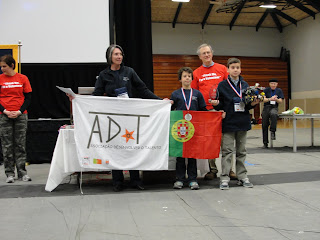
The winner in the category "Junior Division 2011" was a Portuguese  team, students from ADoT "Associação Desenvolver o Talento", Guarda (Portugal).The two students team Miguel Seabra and José Delgado (12 and 13 years old) 


ADoT team winner and teachers


Desenvolver o Talento (ADoT), Portugal

ADoT is a Portuguese association to aid gifted young people and improve the quality of their lives.


Congratulations to ADoT students and teachers!


G-Souto
11.04.2011
Copyright © 2010G-Souto'sBlog, gsouto-digitalteacher.blogspot.com®


Credits: video SapoNotícias
            Photos ADoT


References:


The Portuguese Robotics Open 2011 (Portugal)
http://robotica2011.ist.utl.pt/en/


Trinity College Robot Contest 2011 (USA)
http://www.trincoll.edu


ADoT
http://adotportugal.blogspot.com/

Some apps for iPad helping education


Some apps for iPad helping your learning skills in school! Interesting apps and well demonstrated.


G-Souto
21.01.2011
Copyright © 2010G-Souto'sBlog, gsouto-digitalteacher.blogspot.com® 


Credits: (included in video presentation)


Robotics in Education Seminar


O Centro de Competência em Tecnologias e Inovação, do Instituto de Educação da Universidade de Lisboa, vai realizar no próximo dia 13 de Janeiro, às 16h00, um seminário subordinado ao tema Robótica Educativa.

Este evento decorrerá no Anfiteatro do Instituto de Educação (Edifício da Faculdade de Psicologia e Ciências da Educação, na Alameda da Universidade).

A entrada é livre mas sujeita a inscrição prévia.

Poderá ler o programa aqui


Robotic in Education Robotic will take place in Lisbon, Portugal, January, the 13th - 2011 at the "Centro de Competência em Tecnologias e Inovação" of the Instituto de Educação Universidade de Lisboa.

Read the programme here (PT). You must register for free here

O kit de robótica LEGO MINDSTORMS NXT foi desenvolvido pela LEGO essencialmente para a educação e reúne condições particularmente vantajosas na aprendizagem da programação. 

Pouco utilizado em Portugal, o kit Lego Mindstorms tem vindo a ser utilizado no Ensino Básico e Secundário noutros países, nomeadamente, nos Estados Unidos da América, na Dinamarca e no Brasil, com relatos de bons resultados. 

Segundo Carlos Almeida, a sua utilização seria um sucesso no âmbito do Ensino Básico ou nos cursos profissionais bem como a sua integração nas disciplinas de programação. 

O kit LEGO MINDSTORMS poderá também ser utilizado em projectos realizados nas escolas e na preparação e participações futuras dos alunos em concursos de robótica, como por exemplo, o concurso anual robotop.

Para participar nas diferentes competições, os alunos poderão ter entre oito e dezanove anos.


The LEGO MINDSTORMS NXT robotics kit was developed by LEGO primarily for education and have the all the advantageous in learning programming.

In Portugal, schools don't use it very much, but there are some countries such as the United States of America, Danemark and Brazil that use it in primary and elementary schools with good feedback.  

The kit LEGO MINDSTORMS can help students in robotics projects in order to participate in robotic contests, for example, the Robotop contest.

Exit Camp for Girls the young Portuguese girls showed their talent against the British team that were participating in an equivalent program that runned on IBM in the UK. The victory of the Portuguese robots against the British team was a very interesting point.

The aim was to promote Technology among young girls to increase gender equality in their future career.


Last December, the 30th - 2010, The Guardian published "Dawn of the age of the robotic" by Marina Gorbis, futurologist and head of Californian thinktank The Institute for the Future.


"Advancement in robotics will dominate next decade"
Marina Gorbis, head of the Institute for the Future


G-Souto
07.01.2011
Copyright © 2010G-Souto'sBlog, gsouto-digitalteacher.blogspot.com® 


Google Body Browser


Google’s latest 3d venture, an interesting WebGL application called Body Browser, allows your students to explore the human body just like they can explore the world in Google Earth.


In Science classroom, the students can to tour the inner-workings of the human body.  They can zoom in to see the muscular and skeletal systems, fly around the organs, and go inside the brain. Students can peel back anatomical layers, zoom in, click to identify anatomy, or search for muscles, organs, bones and more


Take a look at the video below to see how it works.


An excellent resource for the kids to get a deeper understanding about how our bodies work, don't you think?


Note: As body browser is still in beta, you need to have the latest version of Google Chrome, or Firefox 4.0b1


G-Souto
06.01.2011
Copyright © 2010G-Souto'sBlog, gsouto-digitalteacher.blogspot.com®