"Developing, Recognising and Embedding Media in Education and Training: Towards the Era fo Digital Fluency"
The Media & Learning Brussels 2010 conference was organised by the Flemish Ministry of Education and Training and the media company ATiT with the support of the European Commission, DG Education and Culture in the context of the Belgian Presidency of the European Union.

Media & Learning Conference
Flemish Ministry of Education
It took place on 25-26 November 2010 in the Flemish Ministry of Education and Training headquarters in Brussels and involved over 230 participants from 31 countries who discussed together the application of media in teaching and learning.
The conference evolved around three main themes:
• Digital and media skills and competences
• Fostering the creation of media-based resources at all levels of education and training
• Use and re-use of existing media resources in education and training

Pascal Smet/ Welcome Plenary sesssion
Flemish Minister for Education
Flemish Minister for Education
Media literacy and digital fluency are amongst the most important skills young people can learn or improve in order to find, use and create accurate information to become good creative citizens of a future society. But how can we as educators be sure that our learners are learning better thanks to media?
"Media literacy is the ability to access the media, to understand and to critically evaluate different aspects of the media and media contents and to create communications in a variety of contexts."
Based on the shared goal of digital fluency for all, the conference organisers set up the event to provide participants with an opportunity to consider digital media and media literacy in new and hopefully radically different ways.
The idea behind this conference was to help launch a real and ongoing community of practice of those interested in how best to harness the promise of traditional and new media in the service of learning.


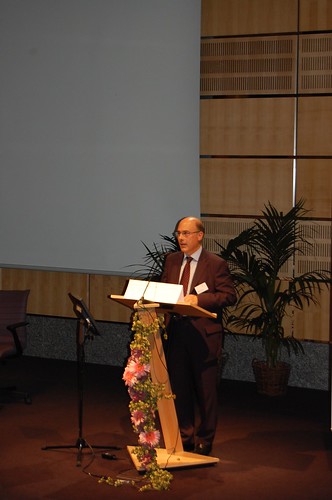
Hans Laugesen
GL, National Union of Upper Secondary School Teachers/Denmark
The conference programme was highly interactive and allowed for maximum networking and sharing of experience with a mix of plenary, discussion, demonstration and workshop sessions.

ICT and media literacy – the policy framework
Hadewych auditoriumDuring two days practitioners, experts and researchers have discussed how learners handle video and audio in a meaningful and thoughtful manner to support their learning, how media repositories complement existing teaching and learning materials effectively, how young people learn by creating their own media and how ICT can enhance the teaching and learning process.
"Media literacy relates to all media, including television and film, radio and recorded music, print media, the Internet and all other new digital communication technologies. It is a fundamental competence not only for the young generation but also for adults and elderly people, for parents, teachers and media professionals."
http://ec.europa.eu

"Media literacy relates to all media, including television and film, radio and recorded music, print media, the Internet and all other new digital communication technologies. It is a fundamental competence not only for the young generation but also for adults and elderly people, for parents, teachers and media professionals."
http://ec.europa.eu

Paul Ashter/ BBC Teachers TV
European policy as well as national policy came under discussion with presentations on the Digital Agenda, Digital Competencies and Media Literacy and Culture. Online and face-to-face discussions on topics such as the best way to teach media literacy and meeting the costs of multimedia-rich educational games attracted a lot of attention, as did the many and varied examples of media usage in schools and colleges.


By mixing the conference with the annual MEDEA Awards which reward excellence in the application of media in learning, the conference programme combined excellent practical examples of media usage.

The workshops given by previous MEDEA Award Winners and Finalists met different participants, most of all, practitioners who were curious about the experiences.
This year’s Media & Learning Conference focused on a changing view of media literacy and developing digital media skills in education, and two core themes emerged as being central.

Keynote speaker Paul Bottelberghs
The first revolved around the fact that society has evolved from a literacy culture to a media culture.
(...)
The second main theme that emerged was that the classroom, university lecture hall or training lab is the place where media needed to be contextualised and perfected
Participants were very enthusiastic about the richness and diversity of the examples of media usage from all over Europe that were shown, serving to highlight the ‘art of the possible’ to everyone who took part.
I chose to participate in the Hadewych auditorium sessions, most of the time, to be informed of the new discussions about ICT and Media Literacy across Europe.
Really liked "Media literacy and culture" by Matteo Zachetti, DG EAC-D. He is responsible for the Media Literacy initiative and the Media Programme Pilot Projects. You can access to his speach here.

Ciarán McCormack, FÍS and IADT, Ireland
Fis bookclub project
http://www.media-and-learning.eu
From the discussions, I took part in the panel "Is media literacy best taught as a unique subject in primary and secondary schools?" moderated by Paul Ashton. The panelists Hans Laugesen and Jim Devine spoke about some innovative practices in their own countries.

The Closing plenary, Friday the 25th, had features keynote presentations "Connected Minds. Is technology changing students expectations?" by Francesc Pedró, (OECD) and BBC News School Report by Ros Smith, BBC, UK.
I really liked the analysis of Francesc Pedrò. Access to his speach here. As last year, in the New Millenium Learners Conference, Dr. Pedrò presented a very clear analysis concerning "growing importance of connectedness" in education.

BBC News School Report has been the "MEDEA Overall Award Winner 2010" & "Professional Production Award Winner 2010". Part of the original team that set up BBC News School Report, Ros Smith is the Deputy Editor on the project.
"BBC News School Report" gives 11-14 year-old students in the UK the chance to make their own news reports for a real audience. Using lesson plans and materials from the BBC News School Report website, and with support from BBC staff, teachers help students develop their journalistic skills to become School Reporters."
Such an interesting project! As I often say, students like to take an active role in their learning as learners: creating, communicating, and collaborating, on methodologic tutoring, of course - formal and informal.
A showcase project I enjoyed! The Fis BookClub from Ireland. Not a new idea but an interactive project to encourage young students to enjoy the benefits of reading.
On the project, children create a video book review based on their independent reading. The concept is simple but convincing.
From the discussions, I took part in the panel "Is media literacy best taught as a unique subject in primary and secondary schools?" moderated by Paul Ashton. The panelists Hans Laugesen and Jim Devine spoke about some innovative practices in their own countries.

Francesc Pedrò/ OECD
Senior policy analyst with OECD
The Closing plenary, Friday the 25th, had features keynote presentations "Connected Minds. Is technology changing students expectations?" by Francesc Pedró, (OECD) and BBC News School Report by Ros Smith, BBC, UK.
I really liked the analysis of Francesc Pedrò. Access to his speach here. As last year, in the New Millenium Learners Conference, Dr. Pedrò presented a very clear analysis concerning "growing importance of connectedness" in education.

Ros Smith/ BBC, UK
BBC News School Report has been the "MEDEA Overall Award Winner 2010" & "Professional Production Award Winner 2010". Part of the original team that set up BBC News School Report, Ros Smith is the Deputy Editor on the project.
"BBC News School Report" gives 11-14 year-old students in the UK the chance to make their own news reports for a real audience. Using lesson plans and materials from the BBC News School Report website, and with support from BBC staff, teachers help students develop their journalistic skills to become School Reporters."
Such an interesting project! As I often say, students like to take an active role in their learning as learners: creating, communicating, and collaborating, on methodologic tutoring, of course - formal and informal.

The MEDEA Awards Ceremony took place on Thursday 25th November alongside the "Media & Learning Conference" and the winners of this year’s awards has been announced.

MEDEA Award/ BBC schoolreporter
Ros Smith
As final comments:
Media literacy is not a new subject, but a new educational language. As Dr. Pedrò said, digital literacy must be revisited (in curriculum, in teacher standards and training). Young people cannot live unplugged.1)
Media literacy is not a new subject, but a new educational language. As Dr. Pedrò said, digital literacy must be revisited (in curriculum, in teacher standards and training). Young people cannot live unplugged.1)
Educators and learners are doing fantastic things in schools! They have wonderful projects, they are envolved in a innovative teaching and learning process.
TV Education is 'on the road' again! Twenty years later, TV supporting teaching and learning is a 'new' media tool (revisited) for educators and learners.
Twenty years ago, I was an educator on TV Education in Portugal (1975-1985). I'm proud to be a digital pioneer! Yes, I am!
I have my degree focus on TV Education from CNDP and BELC, Paris. Those years teaching on TV Education gave me a new dimension and a different vision as an educator EAD and face-to-face.
My students used media devices since very young in the classroom. And they handle with digital tools in formal and informal learning.
So, I could practice teaching and learning in a innovative way some years ago, even when the educational world didn't talk so much about media literacy!
I belong to a group of educators who have pushing out the bounderies of creativity and innovation.
I can say that secondary schools have been pioneers and more innovative than universities using media devices.
I belong to a group of educators who have pushing out the bounderies of creativity and innovation.
I can say that secondary schools have been pioneers and more innovative than universities using media devices.
Oh! An interesting SMS messaging have been used during the conference to support networking.
Congratulations to the conference team! Specially to Nikki Cortoos that I finally met, after two years working together online, and Sally Reynolds.
Thank you so much for your invitation, as a member of the jury, to participate in the conference and in the MEDEA Awards ceremony!
G-Souto
15.12.10
Copyright © 2010G-Souto'sBlog, gsouto-digitalteacher.blogspot.com®
Media & Learning Conference
http://www.media-and-learning.eu/
Conference's Public Report
http://www.media-and-learning.eu
European Commission - Media
http://ec.europa.eu
Conference's Public Report
http://www.media-and-learning.eu
European Commission - Media
http://ec.europa.eu
BBC News Report
1) Francesc Pedrò, Connected Minds. Is technology changing students expectations?, Media & Learning conference, Brussels, 26 November 2010