Showing posts with label NASA. Show all posts

Lunar Eclipse tonight


Planetário Porto | Portugal

The moon will rise in Earth's shadow this evening in a rare lunar eclipse that could turn our natural satellite a deep shade of red.

With clear skies, the celestial spectacle will be visible across many countries, as soon as the moon rises after sunset.


"A total lunar eclipse happens when the moon, Earth and sun line up, and our home planet casts a vast shadow that engulfs the moon.

When the moon moves into the darkest part of the Earth's shadow, the umbra, it will turn a slate grey or brick red colour.

The moon changes colour because blue light - and other short wavelengths - scatter more in the Earth's atmosphere, with more red light getting through."

The eclipse, if visible, could be a spectacular opportunity for photographers and skywatchers. 

The moon will remain low in the night sky, so observers will need a clear horizon and cloudless skies to see it well. Unlike solar eclipses, a lunar eclipse is safe to watch with the naked eye.

The event will be visible in Australasia, southern Japan, a large area of Asia, India, Africa, Europe and the eastern part of South America.

In Portugal the lunar eclipse will be visible in almost all the country. From the six  lunar eclipses of this year, this is the only one that can be visible in Portugal, Azores and Madeira islands. 

The Observatório Português de Astronomia, in Lisbon, will open the doors at 20:30. Several telescopes and other tools for observation will be available for those who want to observe the total eclipse of the moon while the astronomers will explain the conditions under wich eclipse occur.

The total eclipse ends at 22.03pm, when the Moon starts to leave the darkest part of the umbra. 

In the final stage of the eclipse, the moon moves into the lighter part of Earth's shadow, the penumbra, and will likely take on a yellowish hue. 

Education:

The students can be invited to join astronomers and skywatchers at national observaries of Astronomy, observing the lunar eclipse and making some photos or little videos with their smartphones to explore in Science classroom.

An open debate on the subject with colleagues and tutoring by educators will be  an interesting course for all.

The best photo or video should be voted by students.


G-Souto

15.06.2011
Copyright © 2010G-Souto'sBlog, gsouto-digitalteacher.blogspot.com®


Credits: video NASA

References:

The Guardian | Science
http://www.guardian.co.uk


Observatório Astronómico de Lisboa
http://www.oal.ul.pt

The Endeavour ' live ' at Sciences classroom


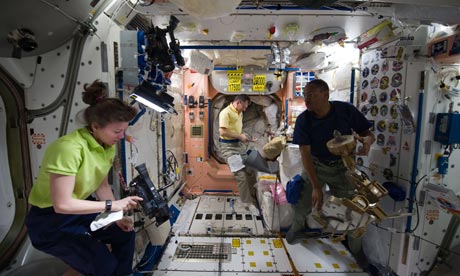
The space shuttle Endeavour lifted off two days ago, May 16, for its final mission.
Tens of thousands of people crowded in and around the Kennedy Space Centre in Florida for the launch of the shuttle's 16-day voyage.
Nasa is planning just one more flight, of the Atlantis in July, before the 30-year shuttle programme is shut down.
"As Americans, we endeavour to build a better life than the generation before and endeavour to be a united nation. In those efforts we are often tested," (...). "This mission represents the power of teamwork, commitment and exploration. It is in the DNA of our country to reach for the stars and explore"
Captain Mark Kelly
Commander the flight


Photo: NASA
NASA says that since Endeavour's launch in 1992 it has travelled more than 100m miles over 25 flights. 
The six astronauts on the shuttle marked the final flight of the Endeavour by posing for a re-enactment of the poster promoting the most recent Star Trek film.

Photograph: Nasa/Reuters. 
Education:
It's impossible to ignore such an important live resource in the Sciences classroom. It's a good opportunity to encourage the students to think about space exploration and its implication to innovation and astrophysics development.


Educators have different resources for different school levels: from primary school to secondary school on NASA Education.


Endeavour crew
Photo: UPI/ Joe Marino/ Bill Cantrell
And NASA TV has a full-time HD Channel available at no cost to cable and satellite service providers. Live coverage of space shuttle mission is online now 24 hours for all. 


So, put on students' devices and link them on this fantastic 'live' classroom!

The students can watch, debate and learn about the space history since the early years until this last mission.


On NASA Education, there are available imagery from NASA’s vast array of space satellites, as well as media briefings, presentations by expert lecturers, astronaut interviews and other special events, all in the improved detail and clarity of high-definition.


The students can find a growing collection of 3D models, textures, and images from inside NASA here. All of the resources are free to download and use.


There are interactive features here.


Even more powerful the Robonaut experience.

And why not watch the video below of the very first moon landing of the Apollo 11 mission in 1969? 

Neil Armstrong was the first man to set foot on the moon with his now legenday words:

 "One small step for man, a giant leap for mankind." 


Impressive at the time! Even now! And the quality of the video! It was in 1969! This is a truly amazing video!


Tomorrow, May 19 PBS NewsHour correspondent Miles O'Brien will interview the crew live between 6 and 6:30 a.m. ET. He will include some questions submitted by viewers. 


Let your students submit their own question(s) visiting the Google Moderator page set up for questions. There is one day left to submit questions.


They can also submit a question via Twitter by including the hashtag#utalk2nasa. A retweet of a tweeted question counts as a vote. The questions posed to the astronauts will be selected from the top vote-getters.


There is some time left to submit questions. Even if students don't get their questions answered, it's still a good exercise to encourage them to think about space exploration.


NASA
Do you want to talk to Endeavour? There's still time to vote and ask questions with Google, PBS and 
The students might follow all the news on Twitter @NASA. Amazing following astronauts tweets. Such an experience, isn't it?

I am sure that students will be very excited about this unexpected lesson!


G-Souto
18.05.2011
Copyright © 2010G-Souto'sBlog, gsouto-digitalteacher.blogspot.com®


References:


NASA
http://www.nasa.gov/


Super Full Moon


Today, March 19th, a full Moon of rare size and beauty will rise in the east at sunset. It's a super "perigee moon"--the biggest in almost 20 years.
"The last full Moon so big and close to Earth occurred in March of 1993," says Geoff Chester of the US Naval Observatory in Washington DC. "I'd say it's worth a look."
Full Moons vary in size because of the oval shape of the Moon's orbit. It is an ellipse with one side (perigee) about 50,000 km closer to Earth than the other (apogee): diagram. Nearby perigee moons are about 14% bigger and 30% brighter than lesser moons that occur on the apogee side of the Moon's orbit.
Contrary to some reports circulating the Internet, perigee Moons do not trigger natural disasters. The "super moon" of March 1983, for instance, passed without incident. And an almost-super Moon in Dec. 2008 also proved harmless.
"Okay, the Moon is 14% bigger than usual, but can you really tell the difference? It's tricky. There are no rulers floating in the sky to measure lunar diameters. Hanging high overhead with no reference points to provide a sense of scale, one full Moon can seem much like any other."
Dr. Tony Phillips | Credit: Science@NASA

Education:
A good video to display in Sciences classroom next monday to explain perigee moon  to the students.

G-Souto
19.03.2011
Copyright © 2010G-Souto'sBlog, gsouto-digitalteacher.blogspot.com®
Credits: video NASA
References:
NASA Sciences, News, Dr. Tony Phillips, Super Full Moon, 16 March 2011